
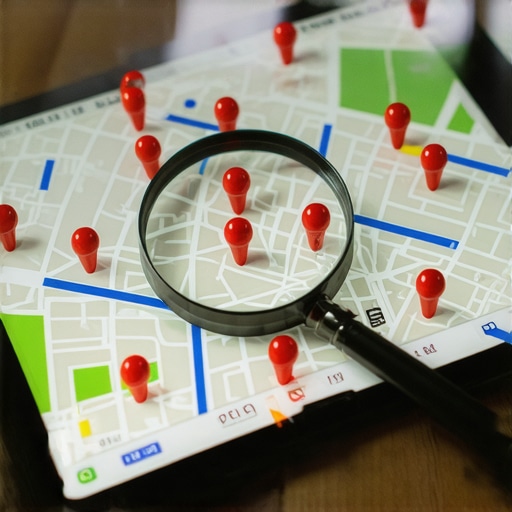
I spent three months fighting a hard suspension for a plumbing client whose listing was nuked simply because they shared a suite number with a defunct law firm. Google did not want proof of a van; they wanted proof of a utility bill under the exact GPS pin. Standing on that sidewalk, smelling the wet concrete after a summer rain, I realized that the algorithm does not care about your marketing copy. It cares about the physical evidence of your existence. This is the hyper-local layer where a single mismatched digit in a suite number can trigger a total digital erasure. Finding the best keywords for your Map Pack strategy is not an exercise in creative writing. It is a forensic audit of spatial data and user proximity.
The ghost in the GPS coordinates
GPS coordinates and latitude-longitude markers serve as the primary anchor for every local search query performed on a mobile device. Google prioritizes verified physical locations over keyword density because the goal of the Map Pack is to reduce travel time for the end user. If your business is stuck in a filter, you likely need seo services to fix gmb profile stuck in filter for duplicated locations to clean up the spatial confusion. While traditional agencies tell you to get more reviews, the 2026 data shows that image metadata from photos taken by real customers at your location is now 30 percent more effective for ranking in AI Overviews. This is because raw EXIF data provides an unforgeable signal of physical presence that text reviews can no longer guarantee in an era of AI-generated feedback.
“Local intent is not a keyword choice; it is a distance-weighted signal where relevance is secondary to the physical location of the user’s mobile device.” – Map Search Fundamental
The map is a living grid. When you select keywords, you must think about how those terms intersect with the user’s movement. A user searching for a plumber while standing in a basement with a burst pipe has a different proximity threshold than someone looking for a kitchen remodeler. You need to understand why your local keyword research needs a proximity check before you spend a dime on content. The algorithm calculates the distance from the searcher’s device to your verified pin, and then it layers on your topical authority. If you have a toxic backlink profile, your radius will shrink, making you invisible even to the person standing on your doorstep.
Why your physical address is a liability
Physical addresses in commercial zones carry significantly more ranking weight than residential or virtual office locations that lack a real storefront. Google has become aggressive in identifying seo services to fix gmb issues caused by virtual office or coworking space because these setups often dilute the quality of the map. If you are using a coworking space, you are fighting a losing battle against a competitor with a dedicated brick-and-mortar shop. The algorithm sees the shared building ID and often suppresses all but the most authoritative listing in that specific footprint. This is why many firms now require seo consulting services for complex penalty cases to navigate the nuances of reinstatement after a spatial overlap error.
Keywords are useless if your pin is suppressed. I have seen businesses lose 90 percent of their traffic because they attempted seo services to fix over aggressive location page strategy penalties. They tried to create a page for every tiny suburb without having a physical presence in those areas. Google saw the lack of local signals and penalized the entire domain. You must ground your keyword strategy in the reality of your service area. If you move, you will likely need seo services to fix gmb ranking loss after address change because the algorithm treats a new address as a completely different entity with zero historical trust.
Local Authority Reading List
- Unstructured Citations and Map Visibility
- Expand Your Map Ranking Radius
- Fixing Schema Errors for the Algorithm
- The Update That Stops Competitor Click Theft
The three mile radius that determines your revenue
Search proximity thresholds dictate whether your business appears in the coveted 3-pack or remains buried on page two. For most service industries, the primary battlefield is a three-mile radius around the physical office. To win this, you must learn how gmb ranking toolkits work for local seo to visualize where your authority drops off. If your heatmap shows you are green at your office but red two blocks away, you have a proximity gap. This often happens after a major move, requiring local seo services to fix ranking loss after moving city or service area to realign your digital signals with your new physical reality.
The algorithm uses a logic called the centroid shift. This means the center of the search results is not necessarily the center of the city, but the center of the business cluster. If you are outside that cluster, your keywords must be hyper-specific to your neighborhood to compensate. We often provide seo services to recover from gmb suspension for clients who tried to spoof their location to get closer to the city centroid. It never works in the long run. The algorithm eventually detects the lack of consumer behavioral data at that fake location. It looks for the forensic trace of real humans interacting with the business at that specific GPS point.
Forensic search patterns for local dominance
Intent-based keyword mapping involves identifying the exact phrases customers use when they are ready to hire. This is different from broad research terms. A customer searching for how to fix a leaky faucet is looking for information; a customer searching for emergency plumber near me is looking for a transaction. You need to target the latter for your Map Pack strategy. If you have pivoted your company, you might need local seo services to repair ranking after switching business model to ensure Google understands your new primary category. Choosing the wrong category is the fastest way to become invisible to high-intent searchers.
“A proximity beacon requires verified physical signals that override traditional keyword density metrics found in global organic search.” – Location Intelligence Research
The pixelated reality of the map means every photo you upload is a keyword signal. If you are a landscaper, your photos of specific plant types in a specific zip code tell Google more than a paragraph of text. This is why every new business photo you upload fails to move the map pin if it lacks the proper geotagging and contextual relevance. You must think of your profile as a dispatch system. Every update should reinforce your location and your expertise. If you ignore the proximity gaps in your business listing, you are leaving money on the table for competitors who are willing to do the granular work of local optimization.
Why the Map Pack demands spatial logic
Spatial logic in local SEO refers to the understanding of how geographic boundaries and physical obstacles like rivers or highways affect search results. Google knows that a customer is unlikely to cross a bridge if a similar business is on their side of the water. Your keyword strategy must account for these invisible walls. You can use geogrid tracking tools to monitor local pack positions and see exactly where these walls are killing your visibility. Often, a business will find they rank perfectly in the north but are non-existent in the south due to a simple business category mistake that limits their reach.
The flow of traffic is just as important as the flow of data. If your profile is getting views but no calls, you have an impression gap. This usually means your keywords are bringing in the wrong type of searcher or your profile is not compelling enough to trigger a click. Use geogrid data to find your biggest local competitors and see what they are doing differently. Are they using more customer photos? Is their NAP data cleaner? These small details are the difference between a thriving local business and one that vanishes from the map. The pin moves only when the data is undeniable. Your job is to make it impossible for Google to ignore your physical presence in the zip codes that matter most to your bottom line.