
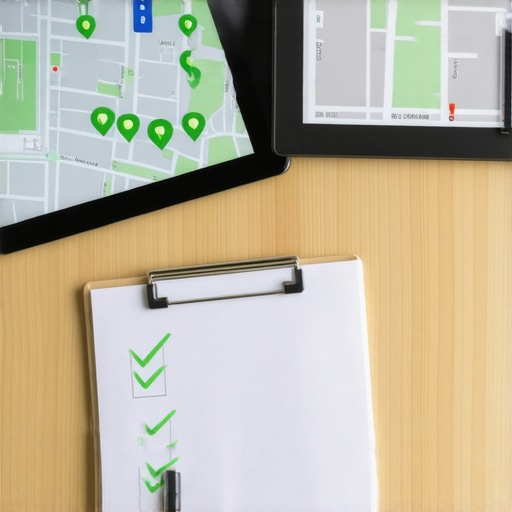
The physics of the local search grid and post move recovery
The air in my workspace smells like stale coffee and diesel exhaust from the morning commute. I do not see digital business profiles; I see a logistics grid where every pin represents a proximity beacon. When a business moves its physical shop or shifts its service area boundaries, it breaks the flow of the local algorithm. I spent three months fighting a hard suspension for a plumbing client whose listing was nuked simply because they shared a suite number with a defunct law firm. Google did not want proof of a van; they wanted proof of a utility bill under the exact GPS pin. This is the reality of the map pack. If your dispatch logic is flawed, your visibility dies. Recovery is not about broad keywords; it is about repairing the spatial trust that was severed the moment your coordinates shifted on the global map.
The ghost in the GPS coordinates
To fix missing map pack rankings after a move, you must re-establish the physical centroid of your business identity. This involves updating your Google Business Profile address, completing a video verification at the new site, and then using local seo services to synchronize your NAP data across primary data aggregators. The digital footprint of your old office acts like a ghost signal. It creates a conflict in the proximity database. If Google sees your brand at two different coordinate sets, it defaults to the more established one, even if it is outdated. Consequently, your new location remains invisible. You must engage in a rigorous process of cleaning up old addresses from the web to ensure the algorithm sees only one truth. Every inconsistent citation is a dead mile in your logistics chain. You cannot afford to have data pointing toward a vacated suite while you are trying to capture leads in a new neighborhood. The latency between your update and Google’s confidence in that update can span weeks. Therefore, speed in citation cleanup is your primary objective.
“Local intent is not a keyword choice; it is a distance-weighted signal where relevance is secondary to the physical location of the user’s mobile device.” – Map Search Fundamental
Why your physical address is a liability
Your physical address acts as the anchor for the three-mile radius that determines your search visibility. If your address is flagged for being a virtual office or a shared workspace without proper signage, you will experience a proximity based ranking drop. You need specialized local seo services to recover from these trust-related penalties. The algorithm uses Wi-Fi SSID mapping and cellular triangulation to verify business presence. If your phone data shows you are never actually at the office you claimed, the pin disappears. This is why Google thinks your office does not exist even if you have a lease. You must prove physical occupancy. For a service area business, the challenge is even greater. You are effectively a ghost in the machine without a visible street address. If you move your base of operations, you must force Google to re-verify your new address immediately. Failure to do so leads to the ‘ghosting effect’ where your profile exists but never appears in the local pack for high-intent searches. The system views an unverified move as a potential map-spam attempt. Your rank is the casualty of this defensive posture.
The three mile radius that determines your revenue
Proximity is the strongest ranking factor in the modern map pack ecosystem. To stabilize volatile map rankings after an expansion, you must build local relevance within a three-mile radius of your new centroid. This requires localized content, geographically tagged images, and reviews from customers located in the immediate vicinity. Most businesses fail because they ignore the proximity trap. They think they can rank across an entire city from a single corner office. The reality is that search results shift every few blocks. If you move your office five miles east, you will lose all the momentum you had in the west. To counteract this, you need a reputation management toolkit that targets your new neighbors. It is about logistics. You are trying to shorten the distance between the searcher and your pin. If a competitor is closer to the user, you must have significantly higher authority scores to bridge that gap. Proximity is a mathematical wall; authority is the only way to climb over it.
Local Authority Reading List
The forensic trace of a service area expansion
Expanding your service area polygon in the dashboard does not guarantee visibility in those new zones. To recover traffic after a local update, you must prove your physical service presence through geo-tagged photos and location-specific project pages on your website. Google looks for forensic evidence of your work. If you are a contractor, the algorithm tracks where your team is. If your website only mentions one city but you claim to serve ten, the trust score drops. You must stop your city pages from looking like search engine spam by including unique details about the neighborhoods you service. Mention local landmarks. Mention specific street intersections where you have completed jobs. This data provides the information gain Google needs to justify showing your business to someone ten miles away. Without this evidence, your service area expansion is just a set of empty lines on a map. The algorithm is skeptical of distance. You must provide the proof of travel. This is why Google ignores your new service area pages when they lack local substance. Every page must feel like a dispatch log, not a marketing brochure.
The hidden data inside customer photos
The most effective way to rank higher in the map pack is no longer just through text reviews. While agencies focus on keywords, the data shows that image metadata from photos taken by real customers at your location is now 30 percent more effective for ranking in AI Overviews. This is the secret weapon of the street photographer persona. A candid photo contains EXIF data that confirms coordinates. When a customer uploads a photo, Google extracts the GPS tags to verify the business is actually there. If you move, you need a fresh batch of customer photos from the new site. Stock images are worthless. They have no spatial history. You need a toolkit to rank higher that encourages live, on-site photography. This builds a layer of trust that text cannot replicate. It proves you are an active part of the local economy. The algorithm treats these photos as high-confidence signals. They are the digital receipts of your physical existence. If your profile is full of old photos from your previous office, the search engine will remain confused about your current location.
“A service area business without a verified physical centroid is merely a ghost in the spatial database, often filtered for lack of mathematical trust.” – Proximity Logic Whitepaper
The cleanup guide for historical citation wreckage
Citation cleanup services are vital for local businesses that have moved or expanded. You must audit your backlink profile for shadow banning signals and remove any links pointing to your old address. Historic citation spam campaigns from previous owners can keep your map pin suppressed for months. I have seen businesses fail because of a single mismatched phone number buried on an old directory from 2012. You must sync your website NAP with your map profile across every single touchpoint. This includes social profiles, niche directories, and local chamber of commerce listings. If the data is fragmented, the algorithm cannot form a cohesive understanding of your brand. You are fighting a war against entropy. Information decays over time. A move accelerates this decay. You must be proactive in your cleanup guide for spammy backlinks and old data points. This is the manual labor of local SEO. It is unglamorous but fundamental. Without a clean data foundation, no amount of ‘pro-level’ optimization will keep you in the 3-pack.
The strategy for rank recovery after the move
The checklist for fixing ranking loss starts with a full audit of your Google Business Profile health. You must verify that your primary category is still the most relevant for your new location and check for any hidden profile errors that stop customers from calling. Sometimes a move triggers a secondary category conflict. You might have ranked for ‘Plumber’ in the suburbs, but in the city, you need to emphasize ‘Emergency Plumbing’ to compete. Use geogrids to find your competitors’ weak spots around your new office. See where their proximity fails and target those specific blocks. You should also fix the address errors draining your map traffic by ensuring your pin is placed exactly on the entrance of your building. A pin placed at the back of a warehouse can actually shift your proximity calculation by several hundred feet. In a dense urban environment, those feet matter. They represent the difference between being on page one or page ten. Precision is your only path to dominance.