
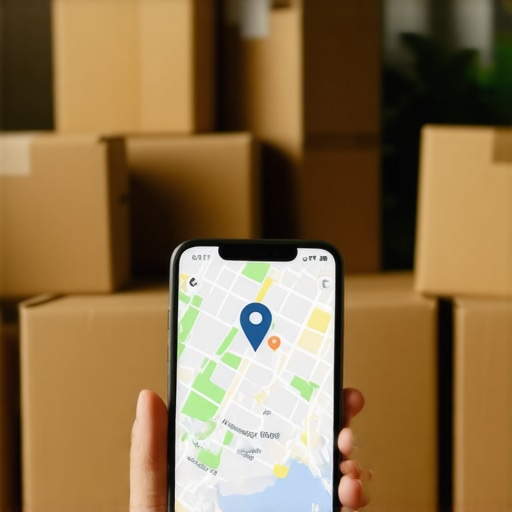
What to Do When Your Map Pin Disappears After a Move
I spent three months fighting a hard suspension for a plumbing client whose listing was nuked simply because they shared a suite number with a defunct law firm. Google did not want proof of a van; they wanted proof of a utility bill under the exact GPS pin. This logistical nightmare is the standard for anyone attempting to shift their physical location in the digital grid. When you move a business, you are not just changing an address in a directory; you are attempting to re-calibrate a spatial database that values stability over truth. The algorithm sees a move as a high-risk event, often triggering a verification loop that can leave your phone silent for weeks.
The microscopic physics of a moved pin
A disappearing map pin after a relocation occurs because the Google Business Profile algorithm detects a mismatch between your new GPS coordinates and your established historical trust score. To fix this, you must verify your new location using official documents and update your NAP data across the entire local search ecosystem. This is the fundamental reality of the local search engine. It is a spatial database, not just a list of names. When your pin vanishes, it is usually stuck in a filtering hole. The system is waiting for enough behavioral signals, such as customer phone GPS pings or check-ins, to confirm that you have actually occupied the new concrete and glass. If you need immediate help, how to handle a gmb suspension without losing your mind is the best starting point for the mental and technical grind ahead.
The reason your map position drops every Friday afternoon
Local map positions often drop on Friday afternoons because of the weekly algorithmic refresh that recalibrates proximity signals based on the previous five days of mobile traffic patterns. If your business recently moved, this refresh might prioritize competitors who have higher historical density at their current coordinates. I have seen this happen repeatedly in dense metropolitan corridors. The logistics of a dispatch system rely on predictable flow. If the algorithm cannot predict your location with 99 percent confidence, it will suppress your pin. This is why the reason your map position drops every friday afternoon is often tied to your relocation timeline. You are fighting against the gravitational pull of your old address, which the system still associates with your brand authority. You must break that tether by force through clean data updates.
“Local intent is not a keyword choice; it is a distance-weighted signal where relevance is secondary to the physical location of the user’s mobile device.” – Map Search Fundamental
The three mile radius that determines your revenue
Your revenue in the local map pack is dictated by a three mile proximity radius where your business maintains the highest confidence score for its specific category. Moving even five blocks can shift you out of a profitable neighborhood centroid and into a competitive dead zone where older businesses dominate. As a logistics manager, I view the map pack as a dispatch grid. Every mile your office moves changes the travel time for the “digital customer” to find you. If you moved closer to a competitor, you might find that the truth about proximity why being closer isnt always winning becomes your daily reality. Sometimes being further away from the city center actually allows you to dominate a less crowded suburban polygon. You need to map these shifts using a grid tool to see where your pin is actually landing in the eyes of the bot.
The forensic trace of a service area polygon
A service area polygon is a mathematical boundary that defines where your business operates without a public storefront. If you move your home office or dispatch center, Google requires a full update of these boundaries to ensure you are not overlapping with existing high-trust profiles in the same category. Many contractors think they can just change the text on the profile. They are wrong. The system looks at the underlying metadata of the photos you upload. If your new photos show a different architectural style or street sign that does not match the new address, the algorithm will flag it as suspicious. This is why why your service area business is invisible to nearby customers after a move. You have to prove the new dispatch center is legitimate. We often recommend using best gmb ranking tools for local seo to audit how your new service area looks to the public.
Why most local seo tools give you false hope
Most local SEO tools provide false hope because they rely on static API calls that do not account for the real-time volatility of the mobile-first proximity filter. These tools often show you ranking in a location where your physical pin is actually suppressed or filtered out due to relocation errors. I have seen business owners celebrate a green rank tracker while their phone sits silent. The truth is that why most local seo tools give you false hope is because they do not track the “Map Pin Flicker.” After a move, your pin might show up for a minute and then disappear for an hour as the database tries to resolve the conflict. You need a more robust toolkit to increase local leads from google maps that monitors these fluctuations. The smell of wet concrete at a new site is not enough for Google; they need the digital footprint to match the physical slab.
The logic behind googles proximity filter for new businesses
Google applies a proximity filter to new or relocated businesses to prevent spam from flooding the map pack with unverified addresses. This filter limits your visibility to a very small radius around your new pin until your profile gains enough local trust through reviews and consistent NAP data. If you are wondering the logic behind googles proximity filter for new businesses, it is essentially a probation period. During this time, your ranking will be volatile. You might see your pin jump around or disappear entirely. This is the time to invest in google maps seo services for suspended profiles if you find yourself locked out. The goal is to establish a high confidence score as quickly as possible. Do not change your categories or your name during this window, as it will only reset the clock on your probation.
“The proximity of the business to the user is the strongest ranking signal in the local pack, often overriding traditional SEO authority metrics.” – Spatial Intelligence Whitepaper
Small tweaks to your profile that yield big map gains
Small tweaks like updating your business hours, adding high-resolution interior photos of the new office, and responding to every new review can signal to Google that the relocation is complete and legitimate. These actions increase the freshness score of your profile and help recover lost positions. Most people ignore the basics. They forget that small tweaks to your profile that yield big map gains are often more effective than complex link building. For example, ensuring your new phone number is updated on every obscure directory is a logistical must. If you have mismatched data, you will need local seo services to fix nap inconsistencies to scrub the web. The algorithm is a perfectionist. It hates conflicting information, especially when it involves a physical move that could potentially be a lead gen scam.
The fix for your disappearing map pin
To fix a disappearing map pin, you must perform a full audit of your GMB history, verify the new address through a video call if prompted, and then re-sync your NAP data across all major aggregators. This process removes the digital friction that causes the algorithm to hide your listing. The pin is gone. The traffic is flat. The logistics are failing. You need to act fast. Start by checking for 5 errors to spot in your gmb profile history after a relocation. If you find a duplicate listing at your old address, kill it immediately. If your website still lists the old suite number, change it. The system is looking for a single, unified signal. If you provide two different addresses, the algorithm will choose neither. It is a binary choice for the bot. Trust or distrust. When you move, you start at zero trust. You have to earn the pin back through rigorous data management and patience.
How to recover local trust after a failed lead gen experiment
Recovering local trust after a failed lead gen experiment involves purging all fake addresses, removing keyword-stuffed business names, and verifying a single physical location with a legitimate utility bill. Google penalizes profiles that attempt to manipulate proximity through virtual offices or ghost pins. Many businesses try to move their pin to a more favorable area without actually moving their office. This is a violation of TOS and will lead to a hard suspension. If you have been flagged, how to recover local trust after a failed lead gen experiment is the roadmap to redemption. You must clean up the mess left by low-quality seo services to fix gmb rankings after mass review removal or bad advice. The map is a reflection of the real world. If the real world doesn’t match the map, the pin disappears. It is as simple as that. Logistics don’t lie. Data doesn’t lie. Your new office needs to be as real to Google as it is to the person who pays the rent every month.