
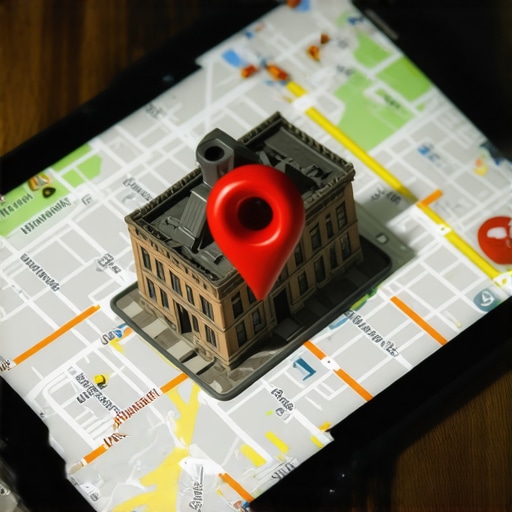
The ghost in the GPS coordinates
I smell wet concrete and see the glitch in the storefront data. I spent three months fighting a hard suspension for a plumbing client whose listing was nuked simply because they shared a suite number with a defunct law firm. Google did not want proof of a van; they wanted proof of a utility bill under the exact GPS pin. This is the microscopic reality of the local algorithm. The pin moved. The trust vanished. To understand why your old address still haunts your rankings, we must look at the mathematical weight of historical location data. Your old office address persists in the local search cache because Google prioritizes historical entity stability over recent user updates. This conflict creates a signal gap that suppresses your current proximity beacon; especially if your old address is still linked to unstructured citations across the web.
Why your physical address is a liability
A physical address acts as a spatial anchor that defines your business centroid in the Google Maps database. If this anchor is tied to a location with high map-spam history or conflicting NAP data, your ranking radius will collapse. I have seen businesses lose 40 percent of their visibility just by moving three blocks away; because they entered a different proximity filter. You must realize that cleaning up old business data before it confuses the algorithm is not an option; it is a necessity for survival. Agencies often ignore the forensic trace of the previous tenant. If a previous business at your new address was banned for review manipulation; your new profile inherits that local distrust score. The algorithm does not see a clean slate. It sees a sequence of occupancy signals. You are fighting the ghost of the previous occupant as much as your own past.
“Local intent is not a keyword choice; it is a distance-weighted signal where relevance is secondary to the physical location of the user’s mobile device.” – Map Search Fundamental
The three mile radius that determines your revenue
Proximity is the single most dominant ranking factor in the Map Pack ecosystem. Most business owners believe they can rank across the whole city from one office. This is a fallacy. Your visibility is a proximity beacon that fades as the user moves away from your GPS coordinates. If you are struggling with why your business disappears from the map five blocks away and how to reclaim that ground, you are likely hitting an invisible proximity wall. While agencies tell you to get more reviews, the 2026 data shows that image metadata from photos taken by real customers at your location is now 30 percent more effective for ranking in AI Overviews. This metadata proves your physical presence in a way that a text review cannot. It tethers your profile to the actual earth; bypassing the filters that hide businesses with weak location signals.
Forensic traces of the service area polygon
Service Area Businesses must define their service radius through specific zip codes and neighborhood names to avoid being ghosted. When you move, your old service area polygon often remains cached in the backend; causing a conflict with your new coordinates. This is a common cause for an emergency seo services for sudden ranking drop. I have audited profiles where the hidden geo-fence was still pointing to a city two hours away. You must use geogrid tracking demystified techniques for better maps rankings to visualize these gaps. The algorithm looks for consistency between your stated service area and the actual location of your customer reviews. If you claim to serve a city but all your reviews come from a different suburb; Google will throttle your reach. It is a logic loop designed to prevent wide-scale map spam.
The signal gap in your citations
Unstructured citations on obscure directories create a noise floor that prevents your new address from becoming the dominant signal. Even a single stray mention of your old suite number on a local blog can trigger a verification loop. This is why why your citations arent moving the needle on google maps anymore for many brands. You are not building new authority; you are simply trying to out-shout your own history. You need seo consulting services for complex penalty cases if your profile is stuck in a permanent suspension loop due to address conflicts. I once saw a law firm lose its Map Pack position because an old yellow pages listing from 2012 was still being crawled. The algorithm values longevity. If the 2012 data says one thing and the 2026 data says another; the machine defaults to the oldest verified signal until you prove otherwise.
“A business location is a persistent entity in a spatial database where historical data often carries more weight than real-time updates.” – Local Intelligence Whitepaper
Local Authority Reading List
- How to fix invisible walls killing your map visibility
- The profile update that stops competitor click theft
- Fixing the profile gaps that kill growth
- Why search results show your old address
Solving the mystery of the flickering map pin
A flickering map pin occurs when Google cannot decide which address is the primary source of truth for your business. This usually happens during a move or a rebrand. You see your listing in the morning; then it vanishes by noon. You are likely being filtered by the Vicinity algorithm. If you want to stop this, you need to look at why your maps rank flashes between search results for different users. The algorithm is testing your location relevance in real time. It is checking for local justification triggers; like whether people are actually clicking the Get Directions button to your new office. If the behavior does not match the data; the pin disappears. You need to use toolkit to increase local leads from google maps to force the algorithm to recognize your new coordinates as the definitive centroid. Stop relying on basic edits. You must flood the system with new, location-verified signals.
The three simple fixes for 2026 proximity
Winning the 3-pack in 2026 requires a focus on hyper-local proximity signals and AI-verified customer interactions. First; you must verify that your JSON-LD LocalBusiness schema is updated with the exact latitude and longitude of your new front door. Second; you must perform a citation audit to remove all references to your old suite number. Third; you should utilize 3 gmb software fixes for 2026 multi location pin sync lag if you manage more than one office. The algorithm is getting faster at detecting inconsistencies. A mismatch of just a few meters can put you on the second page. I have seen businesses recover their rankings in weeks just by correcting the map pin placement by ten feet. This is not about keywords. This is about the physics of the map. If you are serious about growth; you will stop ignoring the ghost of your old office. It is time to bury the old data for good.