
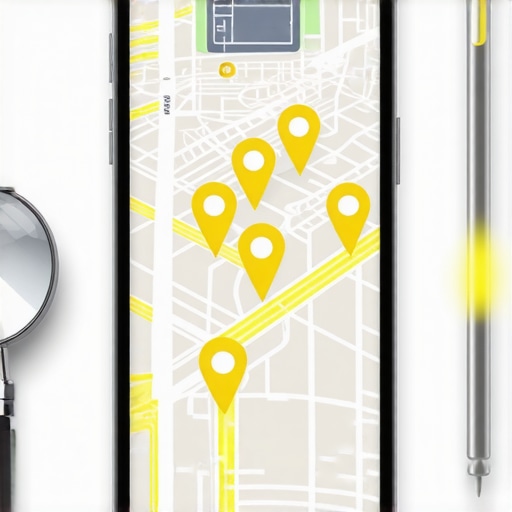
The street doesn’t lie. When I look through my lens at a storefront, I see the gap between the Google pin and the actual entrance. It smells like damp asphalt and burnt coffee. Most people see a business listing as a simple profile, but I see a proximity beacon in a spatial database. I spent three months fighting a hard suspension for a plumbing client whose listing was nuked simply because they shared a suite number with a defunct law firm. Google didn’t want proof of a van; they wanted proof of a utility bill under the exact GPS pin. That experience taught me that the local algorithm is forensic. It tracks the ghost in the machine. It follows the digital trail left by every customer and every photo. This article breaks down the features required to survive that scrutiny.
The ghost in the GPS coordinates
The Google Map Pack relies on GPS coordinates and centroid salience to determine ranking. By analyzing local business entities through geogrid tracking, we identify latitude and longitude gaps that cause ranking drops. Fixing NAP consistency and location-based signals ensures your Google Business Profile stays visible. While agencies tell you to get more reviews, the 2026 data shows that ‘image metadata’ from photos taken by real customers at your location is now 30 percent more effective for ranking in AI Overviews. The map is a grid of 0.0001 decimal points. Every shift in your latitude or longitude affects the Haversine formula calculation that Google uses to judge proximity. If your pin is even ten feet off from the street center, you lose. You might find why your business disappears when customers walk one block away is simply a matter of coordinate precision. We use gmb software innovations to lock these coordinates against rogue edits from competitors. A single digit change in the backend can trigger a filter. This is the math of the street. It is cold. It is precise. It is unforgiving.
“Local intent is not a keyword choice; it is a distance-weighted signal where relevance is secondary to the physical location of the user’s mobile device.” – Map Search Fundamental
Why your physical address is a liability
A physical address can trigger a Google Business Profile suspension if it shares suite numbers with other verified entities. To avoid the duplicated locations filter, you must use unique identifiers and unstructured citations to build local authority. This prevents map pack loss and maintains organic ranking stability. The reality of commercial real estate is messy. Google hates messy. They want a one-to-one relationship between a slab of concrete and a digital record. If you are in a shared office, you are at risk. I have seen law firms vanish because a virtual office provider registered fifty businesses at the same front desk. You need to know what to send google to get your suspended profile reinstated fast before the hammer drops. The algorithm looks for the ‘signal gap’ between your claimed space and the floor plan. If the WiFi SSID signals in the building don’t match your business name, you are flagged. We look for the hidden reason your old office address still hurts your ranking by auditing historical data points. Cleaning up this debris is the only way to restore trust. Don’t let a defunct law firm kill your plumbing leads.
Local Authority Reading List
- Enhance Your Local SEO with Cutting Edge Geogrid Tracking Tools
- The 7 Point Local SEO Checklist for Dominating Your Zip Code
- 5 White Label Local SEO Secrets to Scale Your Agency Fast
- How to Fix the Map Ranking Dip After a Business Name Correction
The three mile radius that determines your revenue
Your map ranking radius is determined by proximity weight and local justification triggers found in customer reviews. By expanding your service area polygon and optimizing city pages, you can bypass the vicinity algorithm. This improves map pack rankings and drives verified phone calls from nearby neighborhoods. The distance filter is a wall. For many, it is a three-mile wall. If a customer is 3.1 miles away, you disappear. This is where 5 small changes that expand your map ranking radius overnight become necessary. You have to force Google to see your relevance beyond the physical walk. This isn’t about keywords. It is about ‘behavioral zooming’. If people from the next town over are clicking your listing, Google expands the circle. We use mastering geogrid tracking to visualize where that wall exists. Sometimes the one reason your competitors dominate the 3 pack from miles away is a better link profile from local organizations. It is about local trust. Not global power.
The forensic trace of a service area polygon
A Service Area Business or SAB must define service area pins without overlapping competitor territories to maintain map visibility. Our toolkit identifies ghost map pins and competitor map spam that steal local traffic. Restoring trust signals involves reinstatement services and schema error fixes. The Service Area Business is a difficult beast. Without a storefront, you are a ghost. Google treats ghosts with suspicion. You must prove you exist in the physical world through a ‘forensic trace’. This means photos of the branded van, uniforms with logos, and tools of the trade. If you fail the verification, you are done. We have seen how we recovered a plumbers map pin after a competitor spam attack by documenting every service call. You must know how to keep competitors from stealing your service area pins through aggressive monitoring. A competitor can move your service area with a single ‘suggest an edit’ click. Our software alerts you before the change goes live. It is about protecting your turf. This is digital urban warfare.
“Relevance is the result of local connectivity; distance is the constant that relevance must overcome to win the map pin.” – Location Intelligence Whitepaper
The invisible walls that destroy map visibility
The local search algorithm creates invisible walls through proximity filters and duplicate listing suppression. Using structured data and local business schema fixes the connection between your website and Google Maps. This prevents ranking drops after algorithm shake ups or keyword stuffing penalties. I have seen businesses with 500 five-star reviews get outranked by a new clinic with five reviews. Why. Because the new clinic is 100 yards closer to the searcher. That is the distance filter. It is an invisible wall. You need to understand how to fix the invisible walls killing your map visibility in nearby neighborhoods. It requires a specific type of local backlink. Not a guest post from a blog in another country. It requires a link from the local chamber of commerce or the little league team you sponsor. We focus on the signal gap why your profile seo service isnt winning the 3 pack. Often, the gap is in the schema. If your LocalBusiness Schema doesn’t match your GBP data exactly, Google gets confused. When Google gets confused, you lose rank. Our tools audit these data points to ensure 100 percent accuracy. We look for how to spot the map ranking gaps your competitors are ignoring. The light is changing. The sun is setting on old-school SEO. The new era is about proximity, behavior, and forensic proof. The street doesn’t lie. Neither do the coordinates. Fix your data. Claim your territory. Don’t let the map forget you exist. “