
3 Signs Your GMB Software is Ignoring Real Search Distance
You open your local SEO dashboard, and it’s a sea of green. Your rank tracker tells you that you are sitting comfortably at Rank #1 for your primary keywords. To any observer, your google business profile seo strategy looks like a masterclass in digital dominance. But then you look at your phone. It’s silent. Your CRM shows no new leads, and your dispatchers are twiddling their thumbs. This is what I call the “Green Grid Illusion.”
In my years of fixing suspended listings and auditing thousands of profiles, I’ve seen this scenario play out for plumbers, roofers, and HVAC contractors across the country. The problem isn’t necessarily your profile; it’s the tools you are using to measure it. Most “lazy” GMB software on the market today provides a sanitized, overly optimistic view of the world that bears little resemblance to how a real customer experiences Google Maps. To truly Why Your Business Disappears When Customers Walk One Block Away, you have to understand the “Holy Trinity” of local search: Proximity, Relevance, and Prominence.
While relevance (keywords) and prominence (reviews and links) are vital, proximity is currently the most heavily weighted – and most misunderstood – factor in the local algorithm. If your software isn’t accounting for the hyper-volatile nature of search distance, it isn’t just giving you bad data; it’s leading you toward a business-killing strategy. In this deep dive, we will expose why your current tools might be lying to you and how to reclaim your spot in the coveted 3-pack.
The Proximity Paradox: Why Distance is No Longer Linear
For years, local SEO was relatively predictable. If you had enough reviews and a decent website, you could rank across an entire city. That changed with the Vicinity Update and was further intensified by the mid-2024 Proximity Boost Update. Google’s algorithm has evolved from measuring simple distance to understanding “hyper-local intent.”
The Proximity Paradox refers to the phenomenon where a business with 500 five-star reviews can be outranked by a “mom-and-pop” shop with 10 reviews simply because the searcher is standing 300 feet closer to the smaller shop. Google is now prioritizing hyper-local results to such an extreme that the “radius of influence” for many businesses has shrunk from miles to mere blocks. If you aren’t using a high-precision google maps ranking service, you are likely missing the “invisible walls” that Google has built around your service area.
Technical detail is key here. We have to account for “Signal Drift.” When a user searches from a mobile device, Google uses a combination of GPS, Wi-Fi triangulation, and sensor data to pin their location within a few meters. However, many older SEO tools rely on IP-based location data, which can be off by miles. This discrepancy creates a massive gap between what your software reports and what your customers actually see. In 2025 and 2026, the local algorithm treats a search from a living room differently than a search from a moving car, even if they are on the same street. This level of granularity is what separates a professional google business profile seo campaign from a failing one.
Sign #1: The “Center-Point” Trap
The most common sign that your GMB software is failing you is the “Center-Point” trap. Many legacy trackers function by checking your rankings from a single coordinate: your business’s physical address. They report that you are #1, and technically, they are right. You are #1 when someone stands in your parking lot. But ranking #1 at your office is meaningless for lead generation.
Real customers search from their homes, their offices, or while they are stuck in traffic. Research from Search Engine Land has highlighted a massive “proximity bias” in the current algorithm. As soon as a searcher moves even a quarter-mile away from your center point, your rankings can drop from #1 to #10. If your local seo software doesn’t allow you to visualize rankings across a multi-point grid, you are flying blind. You might be Stop Wasting Money on Affordable Local SEO That Doesn’t Move the Pin because you are optimizing for a location where your customers aren’t actually searching.
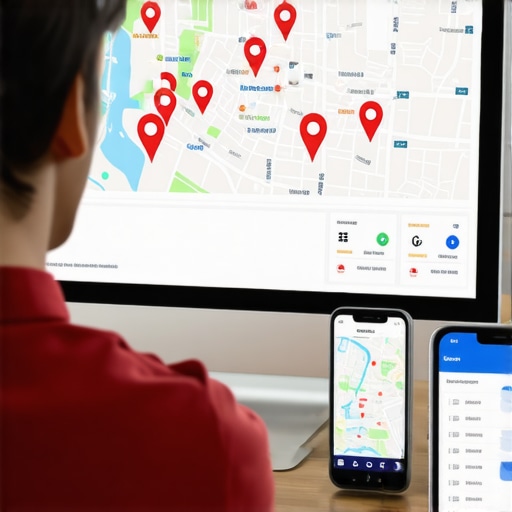
To rank google business profile assets effectively, you need to see the “drop-off zones.” A center-point report hides the fact that your visibility might be blocked by a highway, a river, or simply a competitor who has a stronger “proximity anchor” in a neighboring zip code. High-quality geogrid tracking exposes these gaps, allowing you to see exactly where your “green” turns to “red.”
Sign #2: Failure to Account for “High-Rise Signal Drift” & Urban Density
As we move into 2026, local SEO is becoming increasingly vertical. In dense urban environments – think New York, Chicago, or even mid-sized cities with developing downtowns – proximity isn’t just about North, South, East, and West. It’s about altitude and density. This is where “High-Rise Signal Drift” comes into play.
Standard google maps rank tracker tools often fail to account for how signal interference in dense areas affects search results. In a high-rise building, a user on the 30th floor might get a different Map Pack than someone on the ground floor because their GPS signal is bouncing off glass and steel, or because Google is prioritizing businesses physically closer to the “vertical” location of the user. If your local seo tools are treating a 1-mile radius in a rural area the same as a 1-mile radius in a city center, your data is fundamentally flawed.
I often tell my clients that Why Geogrid Tracking Heatmaps Fail in High-Rise Zones [2026 Fix] is usually due to a lack of understanding of urban density. Google’s algorithm now adjusts the “search sensitivity” based on the number of businesses in a given area. In a dense city, the proximity filter is much tighter. Your software must be able to simulate searches with high-precision coordinates to reflect the reality of urban competition. If it doesn’t, you’ll never understand why you’re losing leads to a competitor three blocks away who has half your review count.
Sign #3: Static Data in a Dynamic AI-Overview World
The local search landscape underwent a seismic shift with the March 2025 Google Update. This update integrated AI Overviews (formerly SGE) more deeply into local intent queries. Now, when someone searches for “emergency plumber near me,” they aren’t always seeing the traditional 3-pack first. They are seeing an AI-generated summary that recommends businesses based on “local experience” and “detailed attributes” found in reviews and website content.
If your gmb seo tools are only tracking the traditional Map Pack, they are ignoring the most significant evolution in search history. Modern google business profile seo requires tracking how distance affects these AI-generated recommendations. AI Overviews tend to favor businesses that have a high “proximity-relevance” score. This means Google isn’t just looking at how close you are, but how relevant your specific services are to that specific micro-location.
Is your software using a google business profile audit tool that evaluates your “attribute density”? If not, you’re missing out. The AI-driven world demands dynamic data. Static rank reports cannot tell you if your business is being mentioned in the AI summary for a searcher five miles away. You need local seo ranking tools that analyze the “sentiment-distance” relationship – how far away can a customer be before the AI stops recommending you because your “local prominence” is diluted by distance?
The Solution: Moving Toward Geogrid Accuracy
The days of simple rank tracking are over. To win in 2025 and 2026, you must embrace geogrid accuracy. A 13×13 or 15×15 geogrid is the only way to visualize the “Invisible Walls” of the map pack. This method allows you to see exactly where your relevance ends and where a competitor’s dominance begins. By Mastering Geogrid Tracking: Boost Your Maps Rank Effectiveness, you can identify specific “cold spots” in your service area and deploy targeted local content or citation bursts to reclaim that territory.
Don’t settle for software that gives you a single number for your ranking. Demand a map. Demand a grid. Demand to see how your business performs at 8:00 AM versus 8:00 PM, as Google also factors in “open now” status and traffic patterns into its proximity calculations. Only then can you build a strategy that actually rings the phone.
Reclaim Your Map Pack Dominance
Proximity is the ultimate gatekeeper of local SEO. If your software is ignoring real search distance, it is essentially keeping you locked behind a digital wall. You need to audit your current tools and ask: “Are these results reflecting a real human’s experience?”
Stop relying on vanity metrics and start looking at the hyper-local data that matters. If you’re ready to see the truth about your rankings and identify the gaps that are costing you thousands in lost revenue, visit the website of SEO Viper Tools today. It’s time to stop guessing and start growing with high-precision geogrid intelligence.