
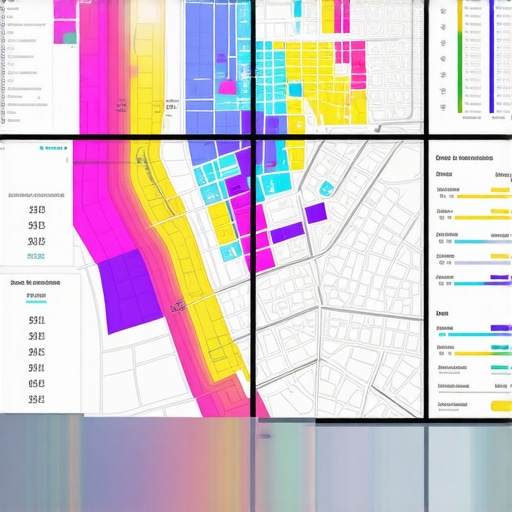
Why Your Map Rank Heatmap Looks Better Than Your Actual Lead Count
The Green Heatmap Paradox: When Visibility Fails to Convert
There is no sight more satisfying for a local business owner or a digital marketer than opening a rank tracking tool and seeing a “sea of green.” Those vibrant #1, #2, and #3 bubbles spread across a geogrid map provide an immediate dopamine hit. It suggests total market dominance. It suggests that every time a potential customer searches for your services, your name is the first thing they see.
But then, you look at your CRM. You check your call logs. You look at the “Request a Quote” notifications in your inbox. The silence is deafening. This is what we call the Green Heatmap Paradox: the frustrating phenomenon where your technical rankings are peak, but your actual lead generation is in the gutter. As a Local SEO Consultant and Google Business Profile Product Expert, I see this daily. Businesses are winning the “ranking game” but losing the “revenue game.”
A geogrid heatmap is a powerful visualization tool, but it is not a bank statement. It measures visibility at specific GPS coordinates, yet visibility is only the first step in a multi-stage journey that leads to a phone call. If you are staring at a perfect grid while your trucks sit idle, you are likely suffering from a disconnect between where Google thinks you are and how users perceive you. Understanding the hidden reason your geogrid heatmap shows rankings you can’t verify is the first step toward fixing your ROI.
Why Heatmaps Lie: The Accuracy Gap and Technical Drift
To understand why your leads aren’t matching your rankings, we have to look at how local seo ranking tools actually function. A geogrid tool doesn’t “see” the internet the way a human does. It sends a request to Google’s API from a precise latitude and longitude, simulating a user at that exact spot. However, the reality of 2026 local search is far more volatile than a static snapshot.
The Centroid Bias and Simulated Coordinates
One of the primary technical reasons for a discrepancy is “Centroid Bias.” Many tracking tools measure from the center of a zip code or a commercial hub, which may not reflect where the actual density of your customers lives or works. Furthermore, Google’s algorithm increasingly uses “Personalization Filters.” If a user has searched for your competitor recently, or if they are currently standing inside a competitor’s physical “proximity circle,” your #1 ranking in the geogrid might drop to #5 for that specific human being.
Time of Day and High-Rise Signal Drift
In 2026, we are seeing more “Time of Day” fluctuations than ever before. Google adjusts the Map Pack based on whether a business is currently open or about to close. If your heatmap was run at 10:00 AM, but your customers are searching at 6:00 PM when you are closed, your rankings – and your leads – will vanish. Additionally, in urban environments, “High-rise signal drift” causes GPS data to bounce off buildings, meaning the “user” Google perceives may be blocks away from their actual location, triggering different search results entirely. You must stop map blind spots with 4 geogrid tracking accuracy checks to ensure your data reflects the messy reality of the real world.
As Kevin Pauls often emphasizes, local SEO isn’t just about the pin; it’s about the infrastructure of relevance. If your technical signals are strong but your real-world presence is flickering, the heatmap is giving you a false sense of security.
Visibility vs. Conversion: Solving the “Click-Through” Problem
Let’s assume your rankings are 100% accurate. You truly are #1 for “plumber near me” across a 10-mile radius. Why aren’t they calling? The answer lies in Google Business Profile optimization. Ranking gets you seen; your profile gets you hired. If your profile is incomplete, outdated, or lacks social proof, users will skip right over the #1 spot to call the #3 spot that looks more trustworthy.
Research from Bridgeway Digital indicates that local searches drive nearly 80% of conversions within 24 hours – but only if the business passes the “instant trust test.” If you want to rank higher on google maps, you must also consider what happens after the rank is achieved.
The Review Gap: Why #1 Isn’t Always the Winner
Imagine a user sees three results:
- Result #1 (You): 4.2 stars, 15 reviews, last review 6 months ago.
- Result #2: 4.9 stars, 150 reviews, last review 2 days ago.
- Result #3: 4.7 stars, 80 reviews, includes a “Book Online” button.
In this scenario, you are the “winner” on the geogrid, but you are the “loser” in the marketplace. The “Review Gap” is a lead killer. Users prioritize recent, high-velocity reviews over raw ranking position.
Visual Trust and the “Zero-Click” Local Search
In 2026, many users perform “zero-click” searches. They find the information they need (phone number, hours, or photos) directly on the Map Pack without ever clicking through to your website. If your profile lacks high-quality, recent photos of your work or your team, you are failing the visual trust test. I have seen 3 tiny profile changes that doubled local map clicks simply by focusing on the “human” element of the listing rather than just the keywords.
The 2026 AI Factor: How AI Overviews (SGE) Change the Game
The landscape of google business profile seo has been fundamentally altered by the full integration of AI Overviews. Previously, the “Local 3-Pack” was the undisputed king of the search results page. Today, AI-generated summaries often sit above the map, or worse, hide it entirely behind a “Show More” toggle.
This “AI Search Hijacking” means that even if you are #1 in the traditional map pack, the AI might recommend a different business based on its analysis of website content, local citations, and third-party mentions. The AI doesn’t just look at proximity; it looks at “Entities.” If the AI summary says, “While [Competitor] is further away, they are specifically noted for emergency 24/7 service,” the user will follow the AI’s recommendation over the map’s ranking. You need to learn how to fix your map rank when AI overviews hide the 3-pack to remain relevant in this new era.
Technical Signal Gaps & Proximity Shrinkage: The 2-Mile Wall
Another reason for the heatmap-lead discrepancy is “Proximity Shrinkage.” Google’s algorithm is increasingly aggressive about showing only the most hyper-local results. You might see green dots 5 miles away on your rank tracker, but in reality, Google is only showing you to users within a 2-mile radius because the competition is so dense.
Using google maps seo tools can help you identify where your “Prominence” signals are failing. Proximity is a fixed variable (where the user is), but Relevance and Prominence are variables you can control. If your “Service Area Business” (SAB) settings are configured incorrectly, or if your physical location signals are weak, your ranking will “flicker.” You might appear #1 for a minute and then disappear the next. This inconsistency is why your maps rank dips every 2 blocks, leading to a massive loss in potential lead volume.
Action Plan: Turning Green Dots into Gold Leads
To bridge the gap between vanity metrics and actual revenue, you need a systematic approach to google maps lead generation tools and profile management. Here is your 2026 checklist:
- Audit Your Categories: Ensure your primary category is exactly what your customers search for, and use secondary categories to capture long-tail intent.
- Automate Review Velocity: Don’t just wait for reviews. Use a system to request them immediately after service to ensure your “recency” signal is always fresh.
- Sync GMB Software: Use high-level tools to prevent “data overwrites” where Google or third-party aggregators change your business hours or services without your knowledge.
- Leverage Geogrid for Expansion: Don’t just celebrate green dots. Look at the “yellow” and “red” areas on the edge of your service area and target those specifically with localized GBP posts and website content.
- Optimize for AI “Entities”: Ensure your website clearly defines your services, service areas, and unique selling propositions so AI Overviews can easily categorize you as the “best” choice.
Conclusion: Beyond the Vanity Metric
A geogrid heatmap is a diagnostic tool, not a trophy. While seeing #1 rankings across the board is a great start, it is meaningless if it doesn’t translate into phone calls. The modern local search landscape requires a balance of technical precision and conversion-focused marketing. By addressing the accuracy gap, overcoming the “Review Gap,” and adapting to AI-driven search changes, you can turn those green dots into a consistent stream of leads. Don’t settle for looking good on a map – focus on being the business that users actually choose to call.